Alibaba launches Qwen-Image-2.0, a unified image model for 2K generation and editing

Joseph Nordqvist
February 10, 2026 at 10:23 AM UTC
4 min read
Alibaba’s Qwen team has launched Qwen-Image-2.0, a new image generation model positioned as a single system for both text-to-image generation and image editing.[1]
The company’s pitch centers on a problem that has troubled image models for years: producing images that look great is one thing, but producing images that look great and contain usable text, layouts, and structured design elements is much harder.
Qwen says Qwen-Image-2.0 aims directly at that gap, highlighting improved typography rendering, 2K (2048×2048) resolution output, and a unified workflow where users do not have to switch between separate “generation” and “editing” models.
What Qwen-Image-2.0 claims to do better
In its launch post, Qwen describes four headline upgrades.
1) Professional typography and long prompts
Qwen-Image-2.0 supports prompts up to 1,000 tokens, which the company says enables direct generation of structured visuals like PPT-style slides, posters, comics, and infographics. The post frames this as a “professional typography rendering” capability, not just short slogans or labels.
2) Higher-resolution, more detailed scenes
Qwen says the model supports native 2K resolution to produce finely detailed realistic scenes, including people, nature, and architecture.
3) Unified generation and editing
Instead of treating “create an image” and “edit an image” as separate modes, Qwen-Image-2.0 is presented as a single model that can do both. Qwen says improvements to realism and text rendering carry across both tasks because the system is unified.
4) Lighter architecture and faster inference
Qwen also claims the model is smaller and faster than earlier versions, positioning it as more efficient to run.
Timeline slide example and why it matters
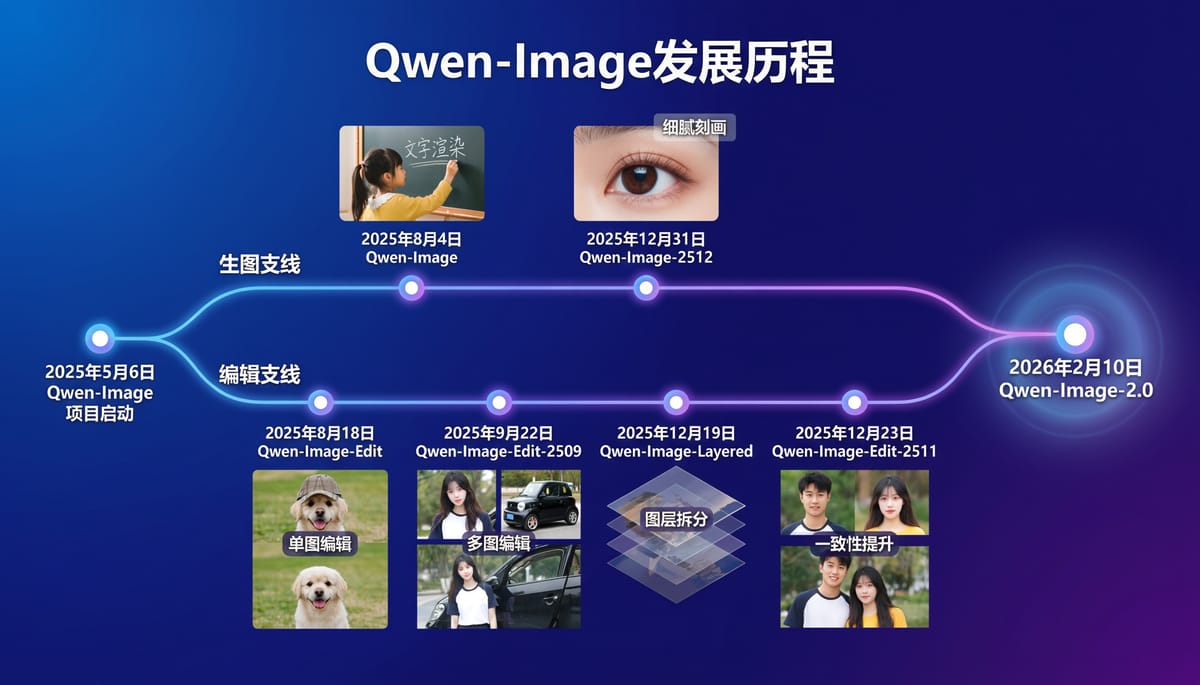
One of the more striking demonstrations in Qwen’s announcement is a timeline slide (embedded above) that the company says was generated directly by the model from a detailed prompt. The point is not just that it can draw a timeline. It is that it can place text accurately, maintain visual consistency across “picture-in-picture” elements, and produce something closer to a ready-to-use slide than a raw image draft.
Qwen’s post repeatedly emphasizes that this is where many image models still struggle: dense text blocks, alignment inside grids, multi-panel layouts, and mixed-language design.
Competitive context: Google and OpenAI are chasing the same “usable design” goal
Qwen-Image-2.0 is launching into a market where the leaders are increasingly pushing beyond “pretty pictures” toward design assets that can be used immediately.
In November 2025, Google DeepMind’s Nano Banana Pro is positioned as a higher-control image generation and editing model for tasks like infographics, diagrams, and text-heavy visuals. Google also highlights improved text rendering, multilingual support, and deployment across products like Gemini, Ads, and Workspace tools.[2]
OpenAI, meanwhile, updated its ChatGPT Images system (available in the API as GPT Image 1.5) in December. The update improved instruction-following and supported more reliable edits that preserve key details.[3] OpenAI also explicitly calls out improvements in “text and layout” type transformations, which overlaps with Qwen’s headline focus on typography and structured compositions.
In other words, Qwen’s announcement fits a broader shift: image models are turning into layout-and-edit engines, not just art generators.
Written by
Joseph Nordqvist
Joseph founded AI News Home in 2026. He holds a degree in Marketing and Publicity and completed a PGP in AI and ML: Business Applications at the McCombs School of Business. He is currently pursuing an MSc in Computer Science at the University of York.
This article was written by the AI News Home editorial team with the assistance of AI-powered research and drafting tools. All analysis, conclusions, and editorial decisions were made by human editors. Read our Editorial Guidelines
References
- 1.^
Qwen-Image-2.0: Professional infographics, exquisite photorealism — QwenTeam, Qwen, February 10, 2026
Primary - 2.
- 3.
Was this useful?