Anthropic launches Remote Control for Claude Code, enabling mobile access
Written by Joseph Nordqvist/
4 min read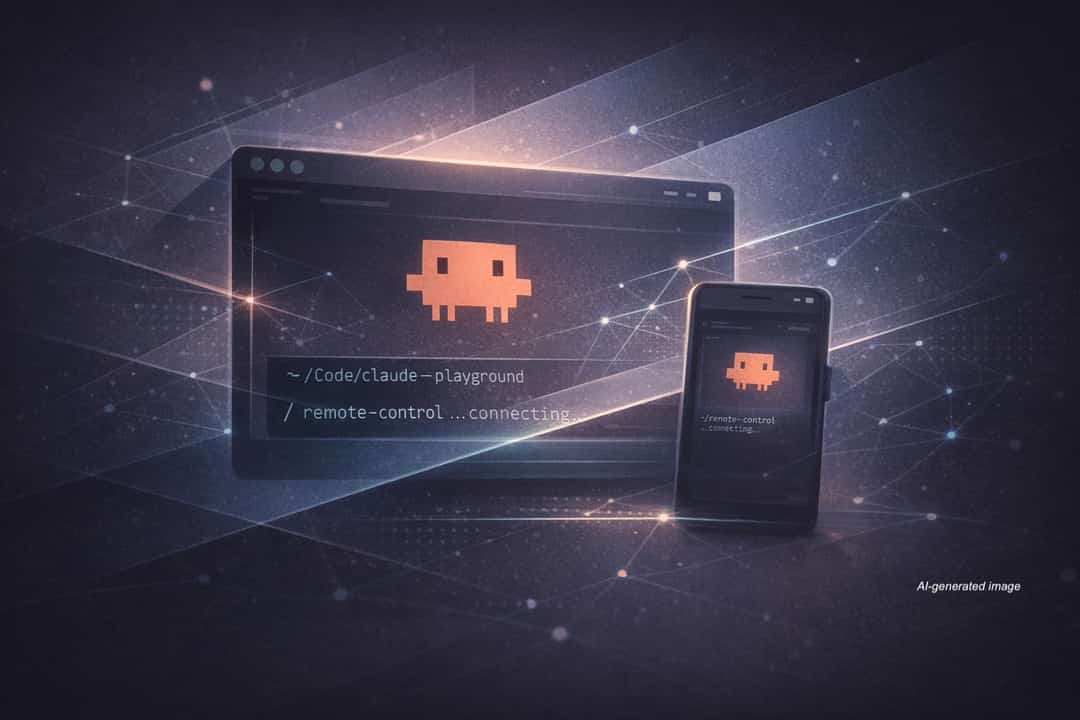
Anthropic released a new Claude Code feature called Remote Control on February 24, 2026, allowing developers to continue local terminal sessions from their phone, tablet, or any web browser. The feature connects the Claude mobile app or claude.ai/code to a Claude Code session still running on the developer's machine, so no code or files move to the cloud.
Remote Control is available immediately as a research preview for Max subscribers (update: as of February 27 it’s also being rolled out to Pro users).
The feature works as a synchronization layer between a local Claude Code CLI session and Anthropic's web and mobile interfaces. A developer starts a new session in Remote Control mode using the command claude remote-control, or can activate it during an existing session with the slash command /remote-control (or /rc for short). The terminal then displays a session URL and an optional QR code for quick phone access.[1]
Developers can also simply open the Claude mobile app or claude.ai/code and find the session by name in the session list, where active Remote Control sessions appear with a green status indicator[1]
Once connected, the developer can send messages and steer Claude from any connected device. The conversation stays in sync across the terminal, browser, and phone. According to Anthropic's documentation, the local machine makes outbound HTTPS requests only and never opens inbound ports, meaning the developer's filesystem, MCP servers, and project configuration remain local throughout the session. [1]
The feature includes automatic reconnection. If a laptop goes to sleep or the network drops, the session stays alive in the background and reconnects when the machine comes back online. However, if the machine is awake but unable to reach the network for more than roughly 10 minutes, the session times out. [1]
Anthropic already offers Claude Code on the web and runs sessions on Anthropic-managed cloud infrastructure. [2] Remote Control takes a different approach. The session runs entirely on the developer's own machine, and the web or mobile interface acts as a window into that local process.
This distinction matters for developers who rely on local tooling, custom MCP server configurations, or project-specific environments that would be difficult to replicate in a cloud sandbox. Anthropic's documentation suggests using Remote Control when continuing local work from another device, and Claude Code on the web when working on repositories not cloned locally or running multiple tasks in parallel [1].
The launch was announced on X by the official Claude account (@claudeai) and Claude Code Product Manager Noah Zweben.
As of publication, Anthropic has not released a dedicated blog post for Remote Control, though it has published full documentation on the Claude Code docs site. [1]
Remote Control arrives during a period of rapid expansion for Claude Code. The product has experienced rapid adoption and reached a $2.5 billion annualized run rate as of February 2026, more than doubling since the start of the year. [3]
Remote Control fills a specific gap: maintaining access to a local development environment without requiring the developer to be physically at their workstation.
The idea of mobile access to Claude Code sessions had already generated community interest and community-built tools had already emerged to address this gap, including open-source projects that used Cloudflare tunnels and custom WebSocket bridges to connect phones to local Claude Code sessions. [4] Remote Control replaces these workarounds with a native, first-party solution.
For developers already using Claude Code as part of their daily workflow, Remote Control removes a practical friction point. Previously, stepping away from a workstation meant either leaving a task running unattended or losing the ability to steer it. Now a developer can start a task at their desk, walk to a meeting, and continue guiding the session from their phone.
The design choice to keep everything running locally, rather than moving sessions to the cloud, preserves the local development context that many developers depend on. This is a meaningful distinction from competing cloud-based coding agents.
UPDATE
On Friday February 27, Noah Zweban, Claude Code PM, announced on X that Anthropic has begun rolling out Claude Code RC to Pro users as well.

Editorial Transparency
This article was produced with the assistance of AI tools as part of our editorial workflow. All analysis, conclusions, and editorial decisions were made by human editors. Read our Editorial Guidelines
References
- 1.
- 2.
- 3.
Anthropic raises $30 billion in Series G funding at $380 billion post-money valuation, Anthropic, February 12, 2026
- 4.
Anthropic just released a mobile version of Claude Code called Remote Control — Carl Franzen, VentureBeat, February 25, 2026
Was this useful?
More in Products
View all- Alibaba launches Qwen 3.5 small model series with sub-1B edge optionsMarch 2, 2026
- Claude Code now remembers what it learns between sessionsFebruary 27, 2026
- Google launches Nano Banana 2, bringing pro-level image generation to its Flash modelFebruary 26, 2026
- Claude Code Security, an AI-powered vulnerability scannerFebruary 20, 2026
Related stories
OpenClaw creator Peter Steinberger joins OpenAI as OpenClaw shifts to a foundation
February 15, 2026
ProductsManus adds Project Skills to its AI agent platform
Manus has introduced a feature called Project Skills that lets teams curate and lock sets of reusable AI workflows at the project level.
February 14, 2026
ProductsGoogle Docs adds Gemini-powered audio summaries
Google is rolling out a new Gemini feature in Google Docs that lets you listen to a short audio summary of a document.
February 14, 2026
IndustryAirbnb says AI now handles nearly 30% of English-language support tickets in North America
February 14, 2026