Microsoft and OpenAI amend partnership, ending cloud exclusivity while preserving Azure-first status
Written by Joseph Nordqvist/April 27, 2026 at 9:13 PM UTC
7 min read- 1.Microsoft and OpenAI amended their 2019 partnership on April 27, 2026: OpenAI can now serve all of its products through any cloud provider, while Microsoft remains the primary cloud partner with first-shipment rights through 2032.
- 2.Microsoft's IP license to OpenAI's models and products is no longer exclusive, and Microsoft also stops paying revenue share to OpenAI.
- 3.OpenAI's revenue-share payments to Microsoft continue through 2030 at the same percentage but are now subject to an undisclosed total cap, and are detached from any AGI milestone.
- 4.AWS chief Andy Jassy confirmed Amazon Bedrock will offer OpenAI models within weeks; Microsoft shares fell 1.3% on the news before recovering.
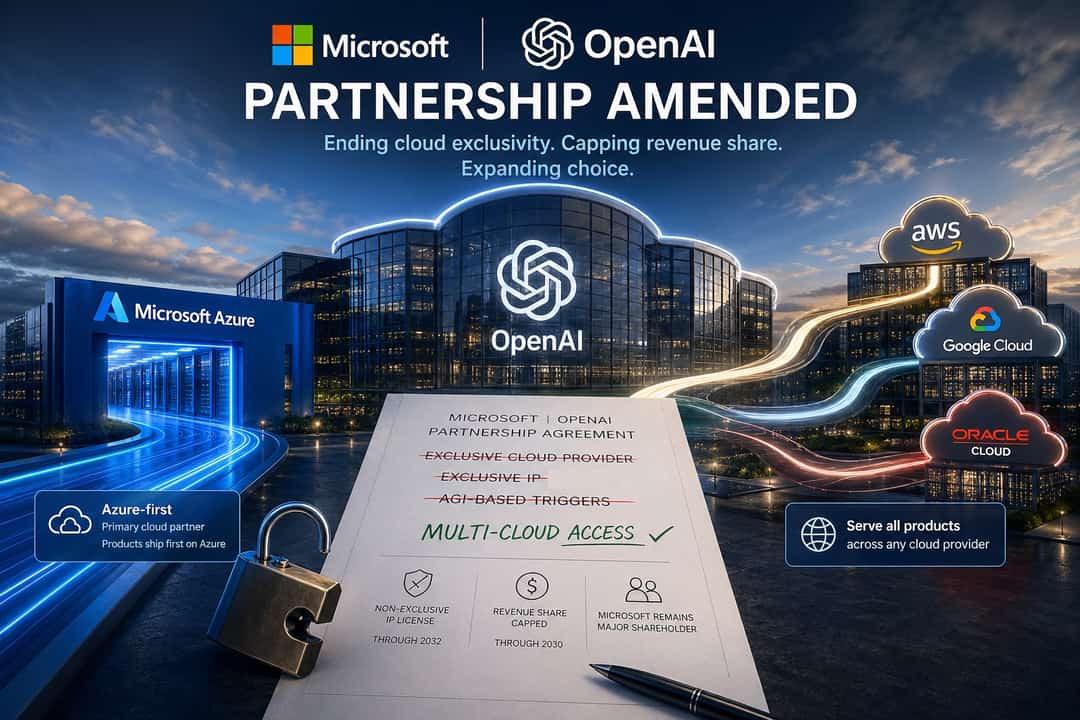
Microsoft and OpenAI announced an amended partnership agreement on April 27, 2026, giving OpenAI the ability to serve all of its products through any cloud provider while keeping Microsoft as its primary cloud partner.
The agreement makes Microsoft's license to OpenAI model and product intellectual property non-exclusive through 2032. It also ends Microsoft's revenue-share payments to OpenAI and caps OpenAI's continuing revenue-share payments to Microsoft through 2030.
The change reduces the role that artificial general intelligence, or AGI, had played as a contractual milestone in the companies' earlier arrangements. OpenAI's payments to Microsoft will now continue through 2030 independently of OpenAI's technology progress.
The amendment resolves several of the most contentious public issues in a partnership that has shaped the commercial development of generative AI since 2019.
What the new agreement says
Microsoft and OpenAI published parallel announcements summarizing the updated terms. Microsoft remains OpenAI's primary cloud partner, and OpenAI products will continue to ship first on Azure unless Microsoft cannot, or chooses not to, support the necessary capabilities.
Beyond that, OpenAI can now serve all of its products to customers across any cloud provider.
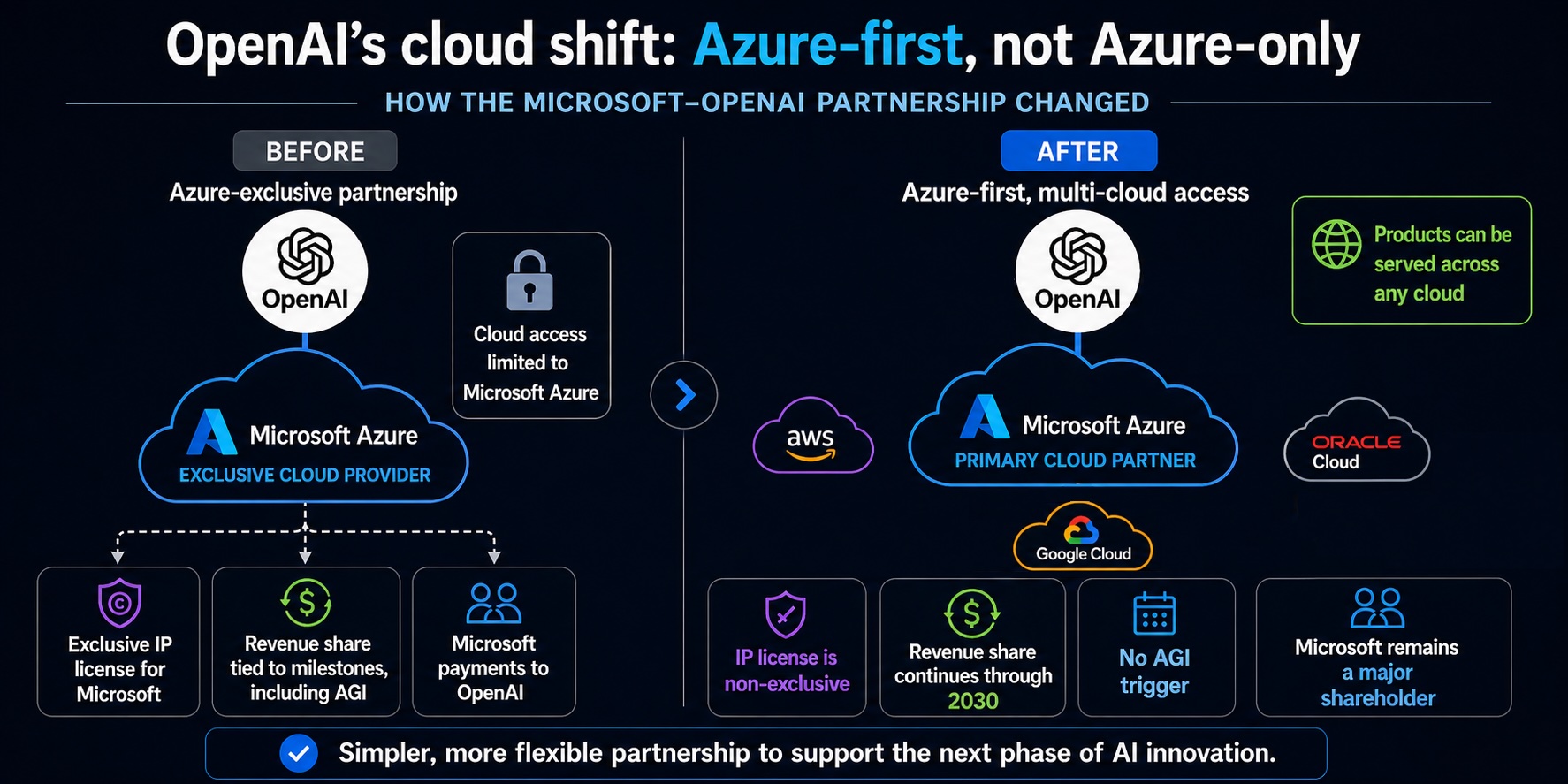
Microsoft's license to OpenAI's intellectual property for models and products runs through 2032, but it is no longer exclusive. Microsoft will no longer pay a revenue share to OpenAI. Revenue-share payments from OpenAI to Microsoft continue through 2030 at the same percentage, but are now subject to a total cap. Neither company disclosed the percentage or the size of the cap.
Those payments also continue independently of OpenAI's technology progress, meaning they are no longer tied to a capability milestone such as AGI.
Microsoft remains a major shareholder in OpenAI.
Neither company disclosed the detailed scope and exclusions of Microsoft's non-exclusive IP license.
Background: the 2019 deal and the October 2025 recapitalization
Microsoft first invested in OpenAI in 2019 and has put more than $13 billion into the company since then. The original partnership tied OpenAI closely to Azure as its exclusive cloud provider and gave Microsoft broad rights over OpenAI's technology.
Several parts of the earlier relationship were also structured around what would happen if OpenAI declared that it had reached AGI.
In October 2025, OpenAI completed a recapitalization that restructured its for-profit arm into a public benefit corporation called OpenAI Group PBC, controlled by a nonprofit foundation. As part of that restructuring, Microsoft's stake was valued at about $135 billion, or roughly 27% of the company on an as-converted diluted basis.
OpenAI also committed to purchasing an additional $250 billion of Azure services, and Microsoft gave up its right of first refusal to be OpenAI's compute provider.
The October agreement loosened the partnership but did not end it. In the months that followed, OpenAI continued to expand its cloud relationships. In February 2026, Amazon announced a $50 billion investment in OpenAI, including an initial $15 billion and a further $35 billion subject to certain conditions.
Other large AI companies have also been spreading their infrastructure commitments across more than one provider, a sign that frontier AI developers are moving toward broader multi-cloud arrangements rather than single-provider dependency.
AGI no longer drives the revenue-share arrangement
One of the most closely watched parts of the earlier Microsoft-OpenAI relationship was the treatment of AGI.
Under previous terms, several provisions, including parts of Microsoft's access to OpenAI technology, were tied to whether OpenAI's board declared that the company had reached artificial general intelligence. The October 2025 recapitalization added another layer by requiring any such declaration to be verified by an independent expert panel.
The April 27 amendment changes the practical importance of that structure for revenue sharing.
Under the new agreement, OpenAI's revenue-share payments to Microsoft continue through 2030 regardless of OpenAI's technology progress. In practical terms, that replaces a milestone-based revenue-share trigger with a calendar-based arrangement.
The amendment does not settle debates over AGI as a technical or scientific milestone. But it does reduce the importance of AGI as a legal trigger inside one of the AI industry's most important commercial partnerships.
Cloud market response
The cloud market responded quickly.
AWS chief executive Andy Jassy said Amazon Web Services plans to make OpenAI models available directly to Bedrock customers in the coming weeks. If implemented as described, that would give AWS customers a more direct route to OpenAI models without going through Azure.
Reuters reported in June 2025 that OpenAI planned to add Google Cloud capacity to meet growing compute needs. Analysts expect Google Cloud to be one of the providers positioned to gain additional OpenAI workloads under the amended Microsoft deal.
Microsoft shares initially fell 1.3% after the announcement, according to Reuters, but were little changed by late morning.
Why this matters
The 2019 Microsoft-OpenAI agreement became one of the defining commercial partnerships of the frontier AI era. It tied a leading AI research company to a single cloud provider, gave that provider broad technology rights, and made AGI a formal contractual milestone.
The April 27 amendment substantially loosens all three features.
OpenAI's products can now be served through any cloud provider. Microsoft's IP license continues, but it is no longer exclusive. And the revenue-share arrangement now runs on fixed terms through 2030 rather than depending on OpenAI's technology progress.
For enterprise buyers, that could mean OpenAI models become more widely available through providers other than Azure. For cloud companies such as AWS and Google Cloud, it removes a structural barrier to offering OpenAI's flagship products.
For Microsoft, the deal preserves a privileged position. It remains OpenAI's primary cloud partner, keeps a non-exclusive IP license through 2032, and continues to participate in OpenAI's growth as a major shareholder. But the agreement also confirms that OpenAI is no longer locked into the same level of Azure exclusivity that defined the early years of the partnership.
Outlook
The full effect of the amendment will depend on details that have not been disclosed, including the size of the revenue-share cap, the scope of Microsoft's non-exclusive IP license, and how quickly other cloud providers can offer OpenAI products at scale.
Pricing dynamics for OpenAI models on non-Azure clouds are also unknown.
Microsoft and OpenAI have framed the amendment as a simplification of a partnership that will continue through joint work on data center capacity, silicon, and security applications.
Whether the relationship stabilizes at this new equilibrium or continues to evolve is not yet possible to determine from the public record.

Written by
Joseph Nordqvist
Joseph founded AI News Home in 2026. He studied marketing and later completed a postgraduate program in AI and machine learning (business applications) at UT Austin’s McCombs School of Business. He is now pursuing an MSc in Computer Science at the University of York.
View all articles →This article was written by the AI News Home editorial team with the assistance of AI-powered research and drafting tools. All analysis, conclusions, and editorial decisions were made by human editors. Read our Editorial Guidelines
References
- 1.
- 2.
Was this useful?