OpenAI shares how its internal data agent works
Written by Joseph Nordqvist/January 29, 2026 at 10:50 PM UTC
4 min read- 1.What it is: OpenAI described an internal-only AI “data agent” for employees to query company data in natural language.
- 2.How it works (high level): It uses layered context (metadata, annotations, code enrichment, institutional docs), memory, and evals to improve reliability.
- 3.Why it matters: It shows what “enterprise-ready” AI analytics looks like in practice: permissions, grounding, and continuous testing, not just chat.
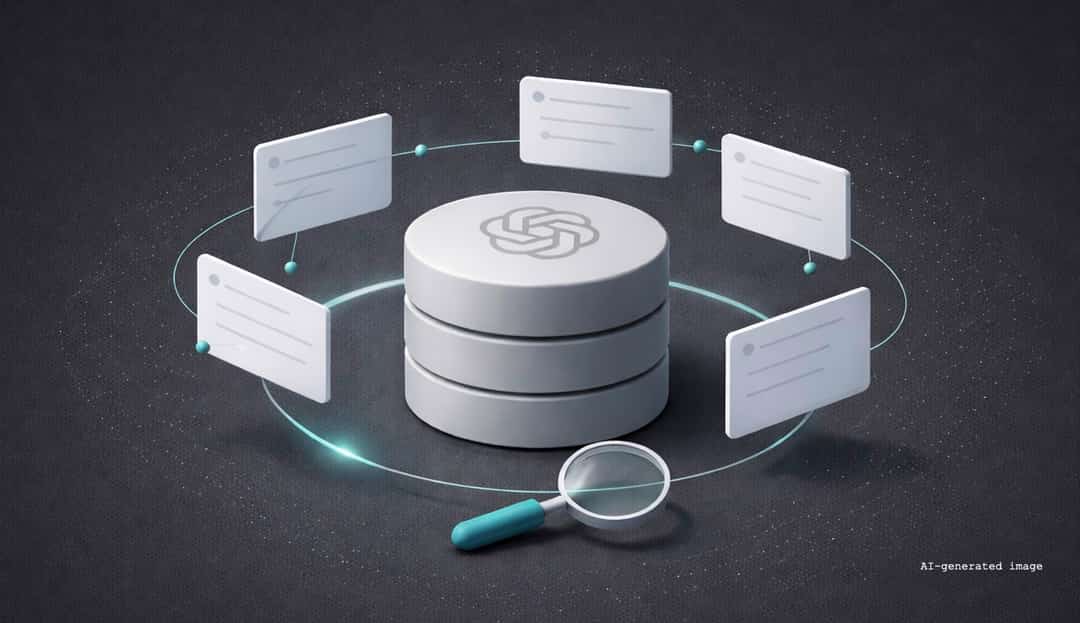
OpenAI published a technical write-up on January 29, 2026 describing an internal AI “data agent” it built for employees to query and analyze OpenAI’s own data systems.[1]
The company says the tool is internal-only and not a product offering, and that it is designed to speed up routine analysis and reduce common errors when working with large, complex datasets.
Context and background
A lot of organizations are adding natural-language interfaces on top of data warehouses so non-specialists can ask questions without writing SQL, or so analysts can iterate faster. Examples include Microsoft’s Copilot experiences for SQL in Fabric[2], Google’s Gemini assistance in BigQuery data canvas[3], and Snowflake’s Cortex Analyst for text-to-SQL style workflows[4].
A core challenge in these systems is grounding responses in the right tables, definitions, and access rules, especially when data is spread across many datasets with similar schemas. OpenAI positions its approach as a response to those practical problems at internal scale.
Key details
OpenAI says it built the agent to operate over a large internal data platform, citing more than 3,500 internal users, over 600 petabytes of data, and around 70,000 datasets.

The agent is described as being powered by GPT-5.2 and integrated into places employees already work, including Slack, a web interface, and development environments.
OpenAI says the system blends multiple layers of context, including schema metadata, human annotations, code-derived understanding of how tables are produced, institutional documentation, and a memory mechanism that can retain corrections for future use.
For retrieval, OpenAI describes using retrieval-augmented generation (RAG) so the agent can pull relevant embedded context rather than scanning large stores at runtime.
On reliability, OpenAI says it uses evaluation pipelines that compare both generated SQL and resulting data, and feeds signals into an eval “grader” to track correctness and regressions as the system changes.
On security, OpenAI says the agent enforces existing access controls through “pass-through” permissions, meaning users can only query data they are already authorized to access, and the tool flags missing access or suggests alternatives the user can access.
The company also says the agent is built for transparency by surfacing assumptions and execution steps and linking to underlying query results for inspection.
Why this matters
This write-up offers a concrete example of how a company is trying to make AI systems useful in day-to-day analytical work without treating them as free-form chat tools.
It also highlights where these systems tend to succeed or fail in practice: table selection, definitions, and permissions often matter as much as model quality, and organizations are increasingly combining models with retrieval, evaluation, and auditability features to manage that complexity.
Outlook (uncertain)
OpenAI says it plans to keep improving the agent’s ability to handle ambiguous questions and to strengthen validations, but it does not describe plans to ship this specific internal tool externally.
More broadly, the same pattern is likely to continue across enterprise data products, where vendors add natural-language query and analysis features on top of governed data systems, and then expand them into more workflows over time.[5][6] This is a general industry direction, not a prediction about any one vendor’s roadmap.

Editorial Transparency
This article was produced with the assistance of AI tools as part of our editorial workflow. All analysis, conclusions, and editorial decisions were made by human editors. Read our Editorial Guidelines
References
- 1.
Inside OpenAI’s in-house data agent — Bonnie Xu, Aravind Suresh, and Emma Tang, OpenAI, January 29, 2026
Primary - 2.
- 3.
- 4.
- 5.
The Rise of AI Data Teams: From Chatbots to Autonomous Agents — David Jayatillake, Cube Dev, Inc, May 27, 2025
- 6.
A new era of data engineering: dbt Copilot is GA — Chakshu Mehta, Tom Grabowski, dbt Labs, Inc., March 19, 2025
Was this useful?
More in Industry
View all- OpenAI kills Sora as compute costs force a strategic retreat3d ago
- Cursor publishes Composer 2 technical report, formally crediting Kimi K2.5 as base model3d ago
- Musk sets March 21 for Tesla's Terafab chip factoryMarch 16, 2026
- Anthropic commits $100 million to new Claude Partner Network for enterprise adoptionMarch 15, 2026
Related stories
OpenAI shares Pentagon contract language
OpenAI published excerpts of its agreement with the Department of Defense on Saturday morning. The language is more detailed than expected, yet more ambiguous than it first appears.
February 28, 2026
IndustryMeta signs $60 billion AMD chip deal, gaining a 10% stake in NVIDIA's biggest rival
Meta and AMD announced a five-year, approximately $60 billion agreement to deploy up to six gigawatts of AMD Instinct GPUs, with Meta gaining the option to acquire roughly 10% of AMD through performance-based warrants.
February 27, 2026
IndustryNVIDIA posts record $68.1 billion quarter, but Wall Street wants more
NVIDIA reported record quarterly revenue of $68.1 billion, up 73% year-over-year, but shares fell 5.5% as investors questioned the sustainability of the AI infrastructure cycle.
February 27, 2026
IndustryMeta signs multiyear deal for NVIDIA GPUs
Meta and NVIDIA announced a multiyear strategic partnership deploying millions of Blackwell and Rubin GPUs, standalone Grace CPUs, and Spectrum-X networking across Meta's hyperscale data centers.
February 18, 2026