Google's Lyria 3 Pro generates full songs up to three minutes long
Written by Joseph Nordqvist/March 25, 2026 at 8:40 PM UTC
9 min read
Google DeepMind has released Lyria 3 Pro, a music generation model that creates complete tracks up to three minutes long, a sixfold increase over the 30-second clips produced by the standard Lyria 3 model that launched in February.[1][2] The new model is rolling out starting today across the Gemini app, Vertex AI, Google AI Studio, Google Vids and ProducerAI.[2]
What it does
Lyria 3 Pro's headline capability is structural awareness. Where earlier AI music generators often struggled with long-range coherence across a full track, Lyria 3 Pro is designed to understand the architecture of a song. Users can prompt for specific elements like intros, verses, choruses and bridges, and the model builds transitions between them.[2] Google describes the result as tracks with "professional-grade structural awareness" that maintain musical consistency across the full duration.[3]
The model also supports granular control through natural language. Users can set specific tempos, direct when lyrics start and end within a track, and define vocal styles and acoustic preferences.[2][3] Beyond text prompts, the Lyria 3 family accepts image inputs that influence the mood and atmosphere of the generated audio.[3]
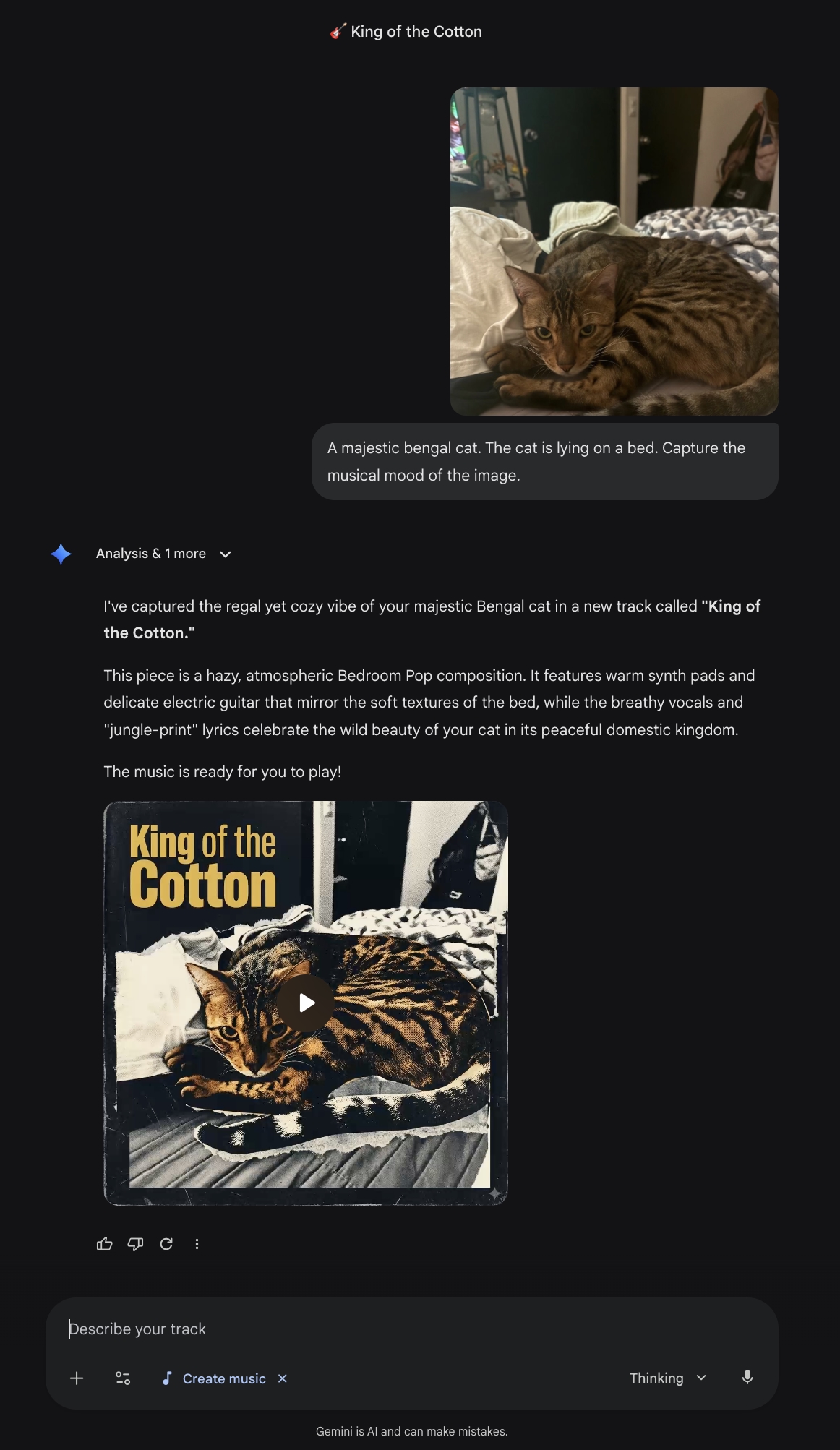
In our testing, we tried both ends of the prompting spectrum. Uploading a photo of my bengal cat lounging on a bed produced a hazy bedroom pop track titled “King of the Cotton”. The model analyzed the image, inferred a mood and generated a finished composition with cover art in seconds.
At the other extreme, a detailed text prompt specifying a dramatic male baritone over a slow orchestral arrangement at 70 BPM, with named instruments, a verse-to-chorus dynamic arc and specific mixing directions for reverb and compression, returned a track called "The Horizon Is A Blade" that followed the brief closely.
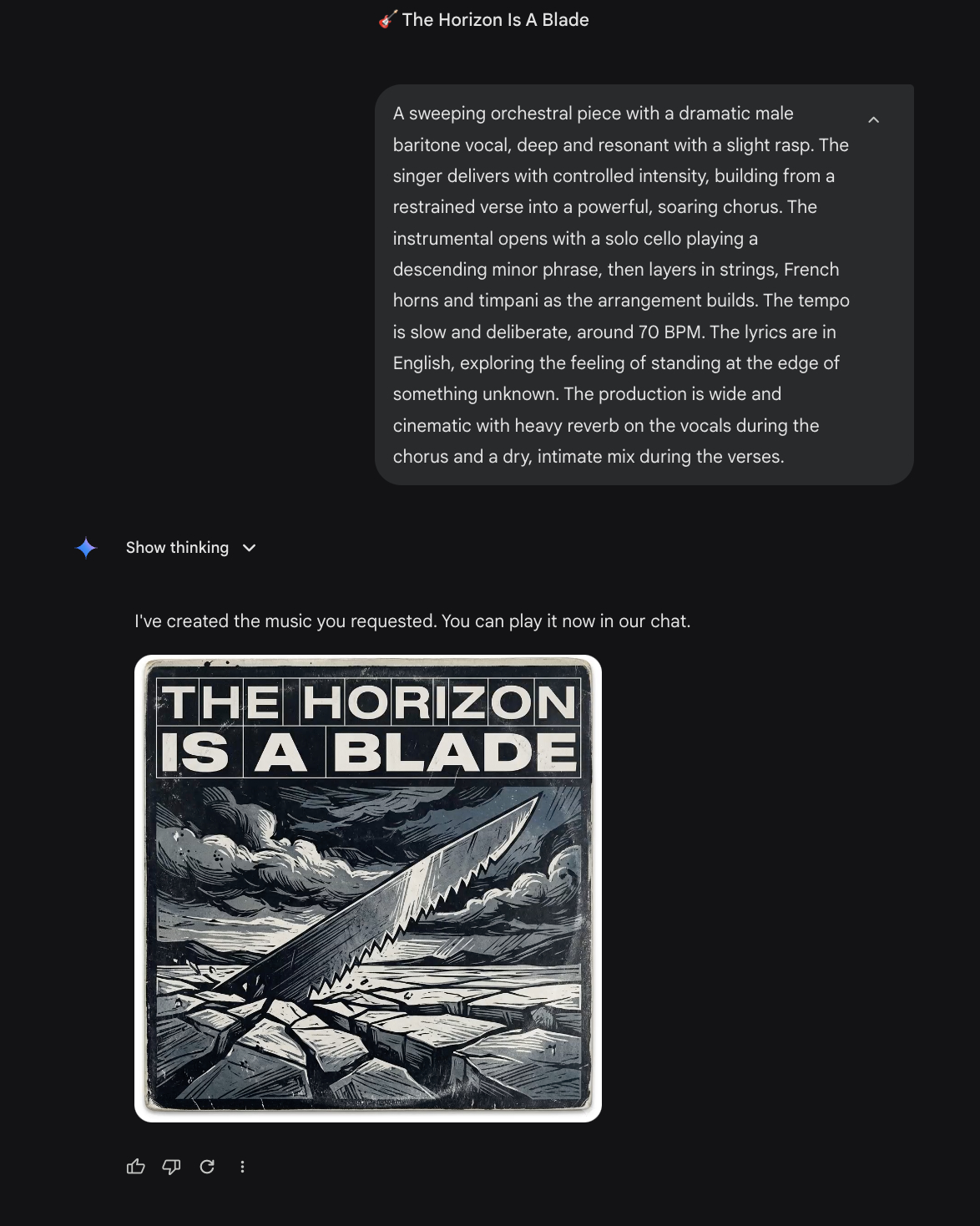
The two demos illustrate the range Lyria 3 Pro is targeting: casual image-to-music generation for everyday users and production-level text control for creators who want to direct every element.
For developers, Google is offering two distinct API variants. Lyria 3 Pro (model ID: lyria-3-pro-preview) handles full-length song generation up to approximately three minutes. A companion model called Lyria 3 Clip (lyria-3-clip-preview) is optimized for speed and generates 30-second clips, intended for rapid prototyping and social media assets [3]. Both are available in public preview through the Gemini API.
Where it's available
Google is pushing Lyria across a broad surface area:
Gemini app: Lyria 3 Pro is available to Google AI Plus, Pro and Ultra subscribers for longer generations with enhanced customization.[2]
Vertex AI: Now in public preview for businesses requiring on-demand audio at scale, targeting use cases from gaming soundtracks to creative tool integration.[2]
Google AI Studio: Both models are available alongside Lyria RealTime in a new dedicated music generation workspace with two creation modes. Text mode accepts natural language descriptions; Composer mode lets users build songs section by section, setting timing and intensity for each part individually.[3]
Google Vids: Rolling out this week to Google Workspace customers and Google AI Pro and Ultra subscribers for adding custom music to video projects.[2]
ProducerAI: The recently acquired music creation platform, formerly known as Riffusion [9], now uses Lyria 3 Pro to offer what Google describes as an agentic experience for iterating on comprehensive songs. It is available globally with free and paid plans.[2][4]
Google has also built demo applications in AI Studio showcasing potential integrations, including a tool that analyzes uploaded video with Gemini 3 Flash and generates a matching soundtrack, and an alarm clock app that creates a daily song incorporating weather, location and calendar data.[3]
Competitive landscape
The release lands in the middle of a rapidly consolidating AI music market. Suno, the current market leader, reported reaching 2 million paid subscribers and $300 million in annual recurring revenue in February 2026, up from $200 million just three months earlier.[5] The company is valued at $2.45 billion following a $250 million Series C [5]. Udio, founded by former DeepMind researchers, has been reshaping its business around label licensing deals that restrict its generated tracks to a walled garden model.[6]
Both Suno and Udio have been settling copyright infringement lawsuits filed by major record labels in 2024. Warner Music Group settled with both companies. Universal Music Group settled with Udio under terms that required the startup to pivot toward a fan engagement platform rather than open-ended generation. Sony has not settled with either.[6]
Google has taken a different approach to the licensing question. The company states that Lyria 3 was trained using materials that YouTube and Google have the right to use under existing terms of service, partner agreements and applicable law.[2] The Lyria 3 model card, which covers Pro and subsequent versions, indicates the underlying architecture uses latent diffusion applied to temporal audio latents, trained on audio datasets annotated with text captions at varying levels of detail.[7]
Google also acquired ProducerAI in February 2026 [4], roughly a week after the original Lyria 3 launch.[1] ProducerAI was originally known as Riffusion, an open-source text-to-music project that went viral in December 2022.[9] The startup had raised a $4 million seed round in 2023, with The Chainsmokers among its backers.[9] Following the acquisition, ProducerAI's team joined Google Labs and Google DeepMind.[4][9]
Safeguards and creative partnerships
All Lyria 3 and Lyria 3 Pro outputs are embedded with SynthID, Google's imperceptible watermarking system for identifying AI-generated content.[2] The model is designed not to mimic named artists. If a prompt includes an artist's name, the model treats it as broad inspiration rather than attempting to replicate their style. Google also employs filters to check outputs against existing content.[2]
On the creative partnership side, Google has been working with musicians through its Music AI Sandbox program. Grammy-winning producer Yung Spielburg used Lyria in the scoring process for the Google DeepMind short film "Dear Upstairs Neighbors". DJ and producer François K used the model in an iterative process to create a forthcoming release. Wyclef Jean has also collaborated with Google on music through the program.[4]
What to watch
Lyria 3 Pro represents Google's bid to compete with dedicated AI music startups while leveraging its unique advantages: a massive existing user base through Gemini, enterprise distribution through Vertex AI, and training data access through YouTube partnerships. At three minutes, Lyria 3 Pro's maximum track length still trails Suno, whose v5 model can generate up to eight minutes in a single pass.[10] Google's pitch rests more on structural awareness and integration breadth than on raw duration, though the quality comparison will depend on real-world use.
The broader question remains whether AI-generated music will complement or compete with human creators. Deezer has estimated that 50,000 fully AI-generated songs are delivered to its platform daily, and the streaming service claims 97% of listeners cannot distinguish them from human-made tracks.[6] Spotify has responded with strengthened policies targeting spam, impersonation and streaming fraud related to AI-generated music.[6] iHeartRadio has gone further, launching a "Guaranteed Human" program pledging not to use AI-generated personalities or play AI music featuring synthetic vocalists posing as human.[6]
For now, Google is positioning Lyria as a creative tool rather than a replacement for human musicianship. Whether the market, the industry and the listening public agree will shape how this technology evolves.
Disclaimer
This article was written with the assistance of Claude by Anthropic and Gemini by Google, as part of AI News Home's commitment to transparency in AI-assisted journalism. All analysis, conclusions, and editorial decisions were made by human editors. Read our Editorial Guidelines

Written by
Joseph Nordqvist
Joseph founded AI News Home in 2026. He studied marketing and later completed a postgraduate program in AI and machine learning (business applications) at UT Austin’s McCombs School of Business. He is now pursuing an MSc in Computer Science at the University of York.
View all articles →References
- 1.
Use Lyria 3 to create music tracks in the Gemini app — Joël Yawili,Myriam Hamed Torres, Google, February 18, 2026
Primary - 2.Primary
- 3.Primary
- 4.
- 5.
AI music generator Suno hits 2M paid subscribers and $300M in annual recurring revenue, TechCrunch, February 27, 2026
- 6.
A Short History of AI-Generated Music: From ‘Fake Drake’ to Blockbuster Legal Settlements, Billboard, March 17, 2026
- 7.
- 8.
- 9.
- 10.
Was this useful?
More in Generative AI
View all- Nvidia DLSS 5, fusing traditional rendering with gen AIMarch 16, 2026
- How ChatGPT and AlphaFold helped an Australian engineer design a personalized cancer vaccine for his dogMarch 16, 2026
- Claude's 1M context window is now generally available with no long-context pricing premiumMarch 14, 2026
- Cursor Automations turns AI agents into background processesMarch 6, 2026
Related stories
Nvidia DLSS 5, fusing traditional rendering with gen AI
Nvidia DLSS 5 introduces a real-time neural rendering model that uses generative AI to enhance game visuals with photorealistic lighting and materials.
March 16, 2026
Large Language ModelsHow ChatGPT and AlphaFold helped an Australian engineer design a personalized cancer vaccine for his dog
A Sydney tech entrepreneur with no background in biology used ChatGPT, Google DeepMind's AlphaFold, and his own machine learning expertise to design a custom mRNA cancer vaccine for his rescue dog.
March 16, 2026
Generative AIClaude's 1M context window is now generally available with no long-context pricing premium
Anthropic has moved the 1 million token context window for Claude Opus 4.6 and Sonnet 4.6 from beta to general availability, and eliminated the long-context pricing premium entirely.
March 14, 2026
ProductsCursor Automations turns AI agents into background processes
Cursor's new Automations let AI agents run in the background, triggered by PRs, PagerDuty alerts, Slack messages, and timers, with no prompt required.
March 6, 2026