Nvidia DLSS 5, fusing traditional rendering with gen AI
Written by Joseph Nordqvist/March 16, 2026 at 10:08 PM UTC
11 min read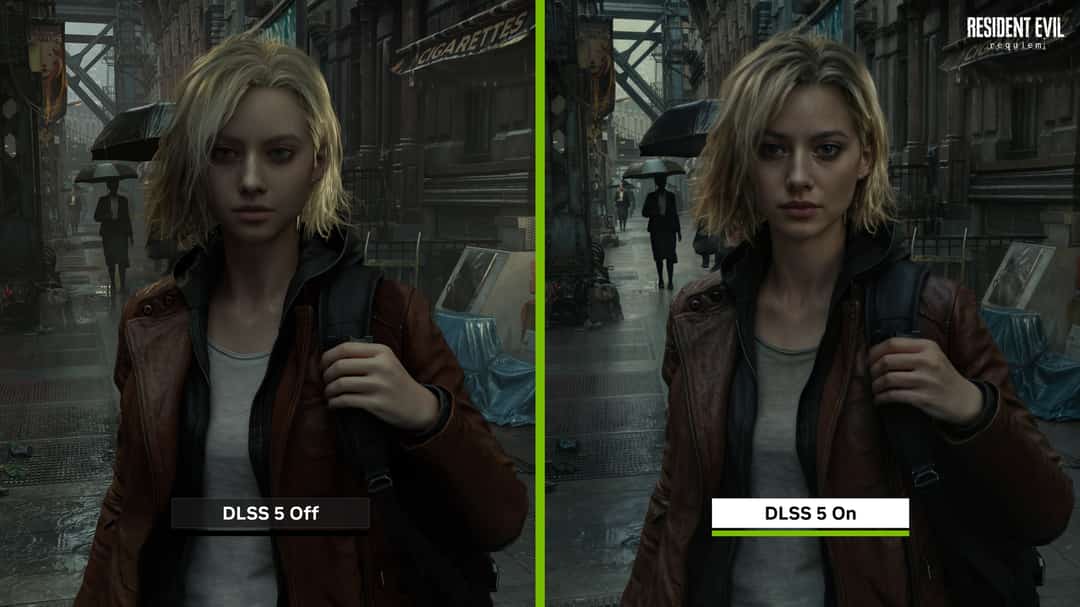
Updated March 18, 2026: This article has been updated with new information about the hardware configuration used in GTC demos, developer and industry reactions to the announcement, and Bethesda's follow-up statement. The original article was published on March 16, 2026.
Nvidia unveiled DLSS 5 at its GTC 2026 conference on Monday, calling it the company's most significant graphics breakthrough since real-time ray tracing debuted in 2018. The technology introduces a real-time neural rendering model that uses generative AI to enhance game visuals with photorealistic lighting and materials, targeting a fall 2026 release.
DLSS 5 fuses two approaches to computing: structured 3D graphics data from game engines and probabilistic generative AI models. CEO Jensen Huang framed the combination as the core of the technology during the keynote. Huang described Nvidia as "the house that GeForce made" and walked through the platform's history before introducing DLSS 5.
What DLSS 5 does differently
Previous versions of DLSS focused primarily on upscaling lower-resolution images and generating intermediate frames to boost performance. DLSS 4.5, announced in January 2026, already uses AI to generate 23 out of every 24 pixels displayed on screen.
DLSS 5 shifts the technology's purpose from performance gains to visual fidelity transformation. Rather than simply sharpening what a game engine renders, the system takes a frame's color data and motion vectors as input, then uses a trained neural model to enhance the scene with dramatically improved lighting and material quality. Nvidia describes the output as "deterministic, temporally stable and anchored to the game's content," distinguishing it from offline video AI models that produce unpredictable results.
The AI model has been trained end-to-end to recognize complex scene elements including characters, hair, fabric, and translucent skin. It handles different environmental lighting conditions such as front-lit, back-lit, and overcast scenarios, working from a single frame of input. Nvidia says the model generates effects like subsurface scattering on skin, fabric sheen, and light-material interactions on hair while retaining the structure and semantics of the original scene.
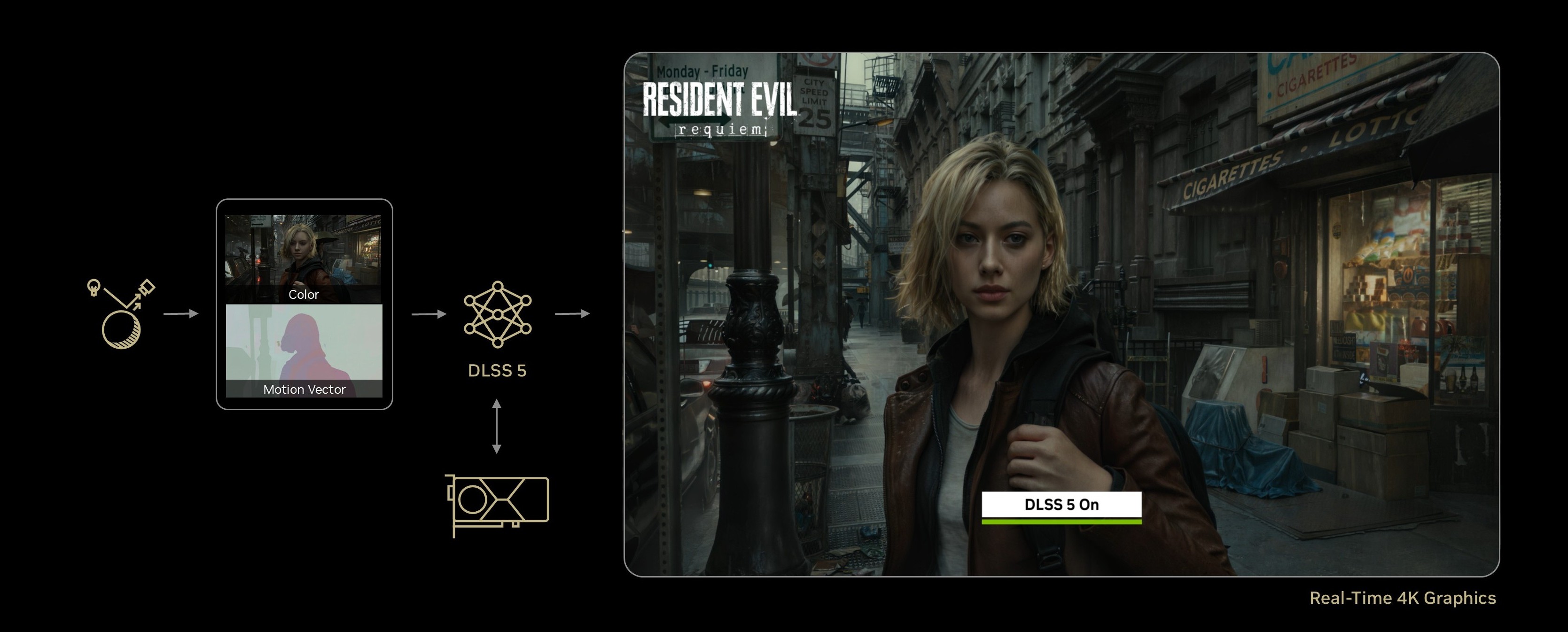
The system operates in real time at up to 4K resolution. Nvidia says it maintains interactive frame rates, though the company has not disclosed specific performance benchmarks or the computational cost of the neural rendering pass.
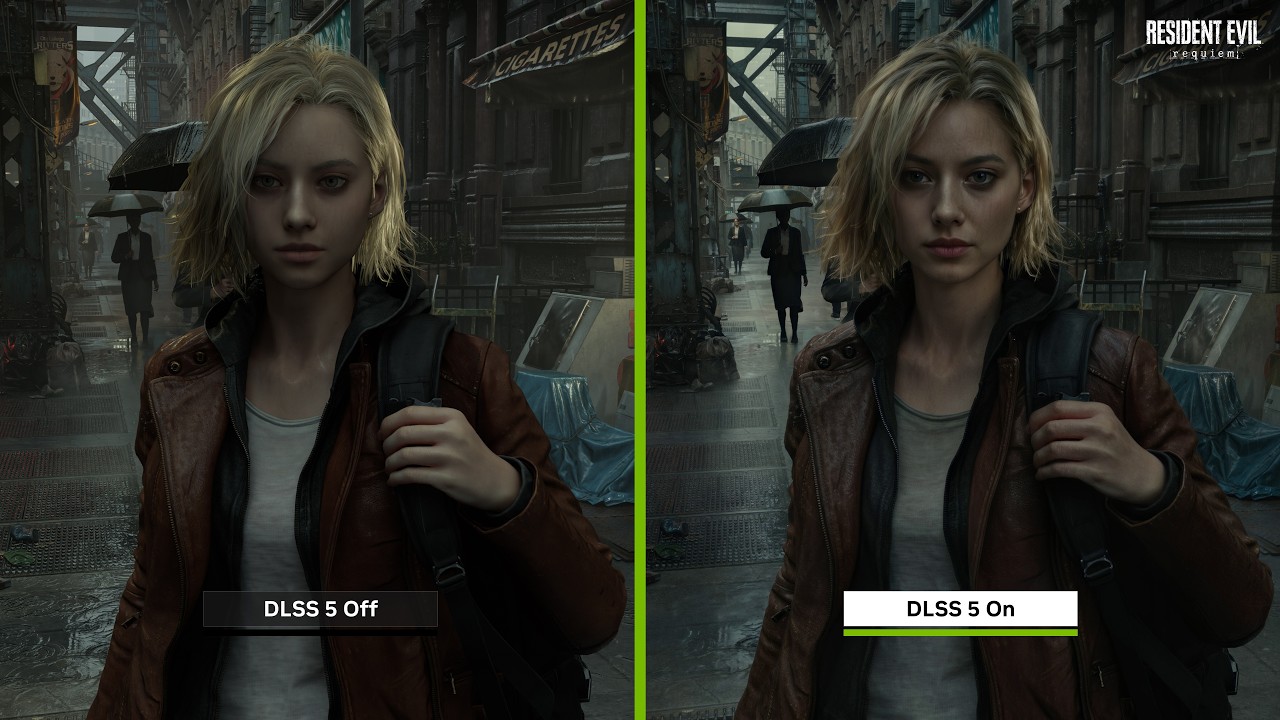
Comparisons (DLSS 5 on and DLSS 5 off)
The rendering gap DLSS 5 is designed to close
Nvidia framed the announcement around a long-standing problem in real-time graphics: the gap between what a game engine can render in 16 milliseconds per frame and what a Hollywood visual effects pipeline can produce over minutes or hours.
The company noted that despite a 375,000x increase in compute power since the original GeForce 3 in 2001, brute-force rendering alone cannot bridge that gap. DLSS 5 is Nvidia's argument that AI-based approaches can close it in a way that raw processing power cannot.
The technology sits at the end of a progression Nvidia traced through its keynote: programmable shaders with GeForce 3 in 2001, CUDA with GeForce 8800 GTX in 2006, real-time ray tracing with GeForce RTX 2080 Ti in 2018, and path tracing with neural shaders on GeForce RTX 5090 in 2025.
Developer controls
Game developers retain control over where and how the AI enhancements are applied. DLSS 5 provides tools for intensity adjustment, color grading, and masking, allowing artists to preserve each game's intended visual style.
Integration uses Nvidia's existing Streamline framework, the same pipeline used for current DLSS and Reflex implementations. This lowers the adoption barrier for studios already working within Nvidia's ecosystem.
Publisher support and confirmed titles
Nvidia announced support from major publishers and developers including Bethesda, Capcom, Hotta Studio, NetEase, NCSOFT, S-GAME, Tencent, Ubisoft, and Warner Bros. Games.
Todd Howard, studio head at Bethesda Game Studios, said: "When NVIDIA showed us DLSS 5 and we got it running in Starfield, it was amazing how it brought it to life."
Jun Takeuchi, executive producer at Capcom, described DLSS 5 as "another important step in pushing visual fidelity forward, helping players become even more immersed in the world of Resident Evil."
Charlie Guillemot, co-CEO of Vantage Studios, said: "The way it renders lighting, materials and characters changes what we can promise to players. On Assassin’s Creed Shadows, it’s letting us build the kind of worlds we’ve always wanted to.”
Confirmed titles include AION 2, Assassin's Creed Shadows, Black State, CINDER CITY, Delta Force, Hogwarts Legacy, Justice, NARAKA: BLADEPOINT, NTE: Neverness to Everness, Phantom Blade Zero, Resident Evil Requiem, Sea of Remnants, Starfield, The Elder Scrolls IV: Oblivion Remastered, and Where Winds Meet.
Nvidia also previewed DLSS 5 running in EA SPORTS FC and a new Nvidia Zorah tech demo (video embedded below).

Hardware requirements and timeline
Nvidia has not published detailed hardware requirements for DLSS 5, but reporting from Digital Foundry and Tom's Hardware following hands-on previews at GTC has revealed that the demos ran on dual RTX 5090 GPUs. One card rendered the game while the second was dedicated entirely to running the DLSS 5 model. Digital Foundry reported that the demos also ran with 2x frame generation enabled, and that DLSS 5 is integrated into the frame generation pipeline.
Nvidia confirmed in an FAQ that the launch version will be optimized to run on a single GPU, and said the dual-card setup reflected the technology's early stage of development rather than its intended consumer configuration. The company said it has not yet begun performance optimizations on the model. PC Gamer reported that Nvidia already has DLSS 5 running on a single GPU internally.
However, the computational gap between a dual-5090 demo and a single consumer GPU is substantial. Nvidia has not confirmed which GPU architectures will support DLSS 5, and the fall 2026 target leaves the company several months to close that gap.
Nvidia also has not disclosed the performance cost of the neural rendering pass. The fall 2026 target suggests the company still has optimization work ahead before the technology is ready for single-GPU consumer hardware.
Industry and developer reactions
The DLSS 5 announcement has generated significant backlash from players and game industry professionals, much of it centered on the technology's visible impact on character faces and game art direction.
In Nvidia's own demo footage of Resident Evil Requiem, the character Grace Ashcroft appeared noticeably altered with DLSS 5 enabled. Multiple observers noted changes to her facial structure, lip fullness, and hair color that went beyond what lighting adjustments alone would explain. PC Gamer reported that the technology "introduces generative AI at the geometry and asset level and can result in dramatic changes to the look of character models".
The term "AI slop filter" began circulating on social media within minutes of the announcement (as seen in the X post embedded below, which has garnered over 16,000 likes). Many members of the gaming community have also attacked the technology as being “anti-art”.
Jeff Talbot, Senior Concept Artist at Gunfire Games (currently working on Darksiders 4), publicly criticized the technology on Bluesky, called it "a garbage AI filter".
Karla Ortiz, an artist who has worked with Ubisoft, Blizzard, and Marvel, described the approach as "disrespectful to the intentional art direction of devs".
Nvidia's official position is that the technology enhances "photoreal lighting and materials" while preserving the game's underlying assets and artistic intent. The company has emphasized that developers have detailed controls over intensity, color grading, and masking, and can exclude specific objects or areas from the effect entirely.
Bethesda Game Studios responded to the criticism on X, distancing itself from the GTC demo footage. "This is a very early look, and our art teams will be further adjusting the lighting and final effect to look the way we think works best for each game," the studio wrote. "This will all be under our artists' control, and totally optional for players".
Separately, Insider Gaming reported that developers and artists at Capcom and Ubisoft learned about their studios' involvement in the DLSS 5 announcement at the same time as the public. "We found out at the same time as the public," one Ubisoft developer told the outlet. Capcom developers reportedly described the announcement as "shocking," given the studio's historically cautious stance on generative AI. Neither Capcom nor Ubisoft has issued an official statement on the report.
At a press Q&A at GTC, Huang pushed back on the criticism directly. "First of all, they're completely wrong," Huang said. "DLSS 5 fuses controllability of geometry and textures and everything about the game with generative AI." He described the technology as "content-control generative AI" rather than traditional generative AI, and said that artistic decisions remain under developers' direct control.
Huang frames DLSS 5 as a broader paradigm
Huang described DLSS 5 as an example of a computing pattern he expects to repeat across industries: combining structured data with generative AI to produce results that are both controllable and highly realistic.
"We fused controllable 3D graphics, the ground truth of virtual worlds, the structured data, with generative AI, probabilistic computing," Huang said during the keynote. "One of them is completely predictive, the other one is probabilistic yet highly realistic."
He pointed to enterprise data platforms such as Snowflake, Databricks, and BigQuery as examples of structured datasets that future AI systems could process using a similar approach. "Future agents are going to use structured databases as well as the unstructured database, the generative database," he said.
Huang called DLSS 5 "the GPT moment for graphics."
Why this matters
DLSS has been integrated into more than 750 games since its introduction in 2018. It is one of Nvidia's most visible consumer-facing AI technologies, and each generation has pushed further into having neural networks handle what traditional rendering pipelines used to do alone.
DLSS 5 represents a qualitative shift in that trajectory. Where previous versions made games faster by doing less traditional rendering, DLSS 5 aims to make games look better by layering generative AI on top of the engine's output. It is, in effect, a real-time visual enhancement system trained on what photorealism looks like.
The practical significance will depend on several factors that remain unresolved: the performance cost on a single consumer GPU, whether the visual enhancements hold up consistently across diverse game art styles and scenarios, and whether developer controls are sufficient to prevent unintended alterations to character models and art direction in practice. The extent to which listed publisher partners have evaluated or integrated the technology at the development team level also remains unclear.
If Huang's broader framing holds, the underlying principle of using structured data as a foundation for generative AI inference could have implications well beyond gaming. But that remains a forward-looking claim, and its practical application in enterprise settings is unproven.
Early demo footage shown at GTC has drawn strong reactions on both sides. The technology's potential is evident, but so are the unresolved questions about artistic control, hardware requirements, and the gap between a controlled demo environment and real-world deployment. Nvidia has several months before the fall 2026 target to address them.

Written by
Joseph Nordqvist
Joseph founded AI News Home in 2026. He studied marketing and later completed a postgraduate program in AI and machine learning (business applications) at UT Austin’s McCombs School of Business. He is now pursuing an MSc in Computer Science at the University of York.
View all articles →This article was written by the AI News Home editorial team with the assistance of AI-powered research and drafting tools. All analysis, conclusions, and editorial decisions were made by human editors. Read our Editorial Guidelines
References
- 1.
NVIDIA DLSS 5 Delivers AI-Powered Breakthrough in Visual Fidelity for Games — Henry Lin, Nvidia GeForce Blog, March 16, 2026
Primary - 2.
NVIDIA DLSS 5 Delivers AI-Powered Breakthrough in Visual Fidelity for Games, Nvidia Newsroom, March 16, 2026
Primary - 3.
- 4.
Nvidia's DLSS 5 uses generative AI to boost photorealism in video games, with ambitions beyond gaming, TechCrunch, March 16, 2026
- 5.
Hands-On With DLSS 5: Our First Look At Nvidia's Next-Gen Photo-Realistic Lighting, Digital Foundry, March 16, 2026
- 6.
We got a first look at Nvidia's DLSS 5 and the future of neural rendering at GTC — the results can be impressive, but there's work to do — Jeffrey Kampman, Tom's Hardware, March 17, 2026
- 7.
NVIDIA DLSS 5 Honors Artist's Intent, Will Be Optimized To Run On Single GPUs At Launch, WCCFTech, March 16, 2026
- 8.
Nvidia has just shown off DLSS 5 coming this fall... and currently it looks a lot like an AI filter, PC Gamer, March 16, 2026
- 9.
- 10.
- 11.
- 12.
NVIDIA CEO Says Gamers Are 'Completely Wrong' About DLSS 5 — Tom Henderson, Insider Gaming, March 18, 2026
- 13.
Was this useful?